Knuth–Morris–Pratt algorithm
The Knuth–Morris–Pratt (KMP) algorithm is a linear time solution to the single-pattern string search problem. It is based on the observation that a partial match gives useful information about whether or not the needle may partially match subsequent positions in the haystack. This is because a partial match indicates that some part of the haystack is the same as some part of the needle, so that if we have preprocessed the needle in the right way, we will be able to draw some conclusions about the contents of the haystack (because of the partial match) without having to go back and re-examine characters already matched. In particular, this means that, in a certain sense, we will want to precompute how the needle matches itself. The algorithm thus "never looks back" and makes a single pass over the haystack. Together with linear time preprocessing of the needle, this gives a linear time algorithm overall.
Contents
Motivation
The motivation behind KMP is best illustrated using a few simple examples.
Example 1
In this example, we are searching for the string  = aaa in the string
  = aaaaaaaaa (in which it occurs seven times). The naive algorithm would begin by comparing
  with
with  ,
,  with
with  , and
, and  with
with  , and thus find a match for at position 1 of . Then it would proceed to compare with , with , and with
  , and thus find a match at position 2 of , and so on, until it finds all the matches. But we can do better than this, if we preprocess and note that and are the same, and and are the same. That is, the prefix of length 2 in matches the substring of length 2 starting at position 2 in ; partially matches itself. Now, after finding that
  match
match  , respectively, we no longer care about , since we are trying to find a match at position 2 now, but we still know that
  match
match  respectively. Since we already know
  , we now know that
  match respectively; there is no need to examine and again, as the naive algorithm would do. If we now check that matches , then, after finding at position 1 in , we only need to do one more comparison (not three) to conclude that also occurs at position 2 in . So now we know that match
  , respectively, which allows us to conclude that match
  . Then we compare with
  , and find another match, and so on. Whereas the naive algorithm needs three comparisons to find each occurrence of in , our technique only needs three comparisons to find the first occurrence, and only one for each after that, and doesn't go back to examine previous characters of again. (This is how a human would probably do this search, too.
Example 2
Now let's search for the string = aaa in the string = aabaabaaa. Again, we start out the same way as in the naive algorithm, hence, we compare with , with , and with . Here we find a mismatch between and , so does not occur at position 1 in . Now, the naive algorithm would continue by comparing with and with , and would find a mismatch; then it would compare with , and find a mismatch, and so on. But a human would notice that after the first mismatch, the possibilities of finding at positions 2 and 3 in are extinguished. This is because, as noted in Example 1, is the same as , and since  ,
,  also (so we will not find at position 2 of ). And, likewise, since
  , and , it is also true that
  , so it is pointless looking for a match at the third position of . Thus, it would make sense to start comparing again at the fourth position of (i.e., with
  , respectively). Again finding a mismatch, we use similar reasoning to rule out the fifth and sixth positions in , and begin matching again at
  (where we finally find a match.) Again, notice that the characters of were examined strictly in order.
Example 3
As a more complex example, imagine searching for the string = tartan in the string = tartaric_acid. We make the observation that the prefix of length 2 in matches the substring of length 2 in starting from position 4. Now, we start by comparing  with
with  , respectively. We find that
  does not match
  , so there is no match at position 1. At this point, we note that since and
  , and
, and  , obviously,
  and , so there cannot be a match at position 2 or position 3. Now, recall that
  and
and  , and that
  . We can translate this to
  . So we proceed to compare with . In this way, we have ruled out two possible positions, and we have restarted comparing not at the beginning of but in the middle, avoiding re-examining and .
Concept
The examples above show that the KMP algorithm relies on noticing that certain substrings of the needle match or do not match other substrings of the needle, but it is probably not clear what the unifying organizational principle for all this match information is. Here it is:
- At each position
 of , find the longest substring of ending at
  that is also a prefix of .
We shall denote the length of this substring by  , following [1]. We can also state the definition of equivalently as the length of the longest proper suffix of the prefix of length which is also a prefix of .
The table  , called the prefix function, occupies linear space, and, as we shall see, can be computed in linear time. It contains all the information we need in order to execute the "smart" searching techniques described in the examples. In particular, in examples 1 and 2, we used the fact that
  , that is, the prefix aa matches the suffix aa. In example 3, we used the facts that
  . This tells us that the prefix ta matches the substring ta ending at the fifth position. In general, the table tells us, after either a successful match or a mismatch, what the next position is that we should check in the haystack. Comparison proceeds from where it was left off, never revisiting a character of the haystack after we have examined the next one.
Computation of the prefix function
To compute the prefix function, we shall first make the following observation:
- Prefix function iteration lemma[1]: The sequence
 contains exactly those values
  such that the prefix of of length matches the substring of length ending at .
That is, we can enumerate all substrings ending at that are prefixes of by starting with , looking it up in the table , looking up the result, looking up the result, and so on, giving a strictly decreasing sequence, terminating with zero.
- Proof: We first show by induction that if appears in the sequence
 then the prefix
 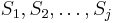 matches the substring
  , i.e, indeed belongs in the sequence . Suppose is the first entry in . Then
  and it trivially belongs (i.e, the prefix of length matches itself). Now suppose is not the first entry, but is preceded by the entry
  which is valid. This means that the prefix of length is a suffix of the prefix of length . But the prefix of length matches the substring of length ending at by assumption. So the prefix of length is a suffix of the substring of length ending at . Therefore the prefix of length matches the substring of length ending at (since
  ).
). - We now show by contradiction that if the prefix of length matches the suffix of length of the prefix of length , i.e., if "belongs" in the sequence , then it appears in this sequence. Assume does not appear in the sequence. Clearly
 since 0 and both appear. Since is strictly decreasing, we can find exactly one
  such that
  and
and  ; that is, we can find exactly one after which "should" appear (to keep the sequence decreasing).
References
- ↑ 1.0 1.1 Thomas H. Cormen; Charles E. Leiserson, Ronald L. Rivest, Clifford Stein (2001). "Section 32.4: The Knuth-Morris-Pratt algorithm". Introduction to Algorithms (Second ed.). MIT Press and McGraw-Hill. pp. 923–931. ISBN 978-0-262-03293-3.

